
Inside the $14 Billion Bet on Programming Immune Cells in the Body
A new Science Immunology paper from Drew Weissman's lab, and what Big Pharma has already paid more than $14 billion to back.

The most interesting thing about the latest Science Immunology paper from Penn isn’t just the science alone. It’s the timing.
Autologous CAR-T retains its durability advantage in refractory hematologic cancers.
Allogeneic continues to chase scale.
In vivo is becoming the third path — and over the last fourteen months it has attracted more capital, faster, than either of the other two did at the same stage.
In the last fourteen months, AbbVie has paid $2.1 billion for Capstan Therapeutics. Eli Lilly has paid up to $2.4 billion for Orna Therapeutics and up to another $7 billion for Kelonia. Bristol Myers Squibb has paid $1.5 billion for Orbital Therapeutics. AstraZeneca has picked up EsoBiotec for up to $1 billion. Gilead’s Kite has acquired Interius BioTherapeutics for $350 million. Combined deal value: well north of $14 billion, on top of separate licensing transactions like Kite’s deal with Pregene Biopharma (up to $1.64 billion) and a string of late-stage venture rounds for the independents.
Every one of those acquisitions is a bet on the same idea:
that the next generation of cell therapy will not be manufactured outside the body and reinfused, but delivered as a temporary instruction directly into the patient.
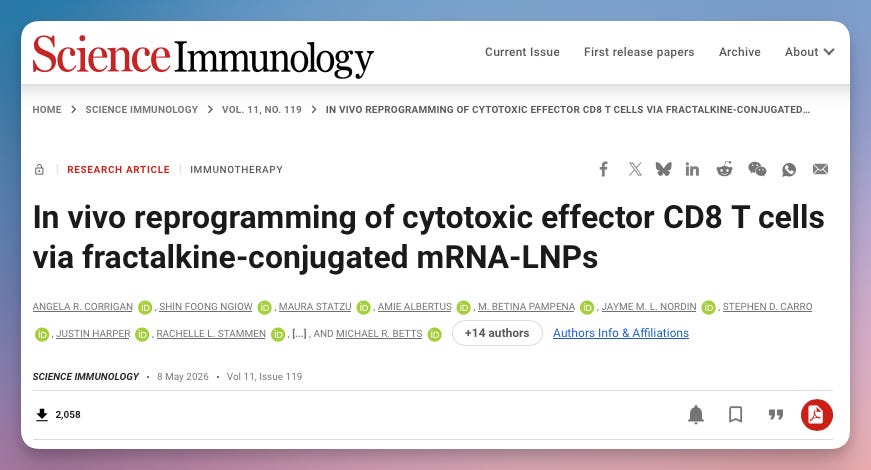
The new paper, led by Angela R. Corrigan with E. John Wherry, Drew Weissman, and the Michael Betts lab, is the latest academic data point in that thesis. It is also, in a way, the academic-side mirror of the commercial bet.
Weissman is a co-founder of Capstan — the company AbbVie just bought.
The paper is what that platform’s underlying biology looks like while still wearing its university lab coat.
What the paper actually shows
The researchers used a lipid nanoparticle decorated with fractalkine — the chemokine also known as CX3CL1 — to deliver mRNA selectively to T cells expressing its receptor, CX3CR1. CX3CR1 is not the antigen-specific T-cell receptor; it is a chemokine receptor associated with cytotoxic effector and antigen-experienced CD8 T-cell states. Using fractalkine as a targeting ligand lets the nanoparticle home in on a defined functional state rather than a broad cell type.
The numbers are striking. In mice, the platform reached up to ~90% of effector CD8 T cells in blood and spleen. In rhesus macaques, the figure was close to 100% of peripheral effector T cells. Expression remained transient, which is the design point — the goal is to hand the cells a short-lived instruction, not to rewrite them.
The instructions tested in the paper were illustrative. In mice, the cargo was IL-2 mRNA, which prompted treated T cells to secrete the cytokine. In macaques, the cargo was mRNA encoding CD62L — a homing molecule that effector T cells normally lack. That is more interesting than it sounds. CD62L is the badge that lets T cells enter lymph nodes; effector T cells, having shed it, are confined largely to the vasculature. Restoring CD62L expression, even briefly, expands where these cells can go.
The authors describe the platform as enabling rapid, efficient, and transient in vivo modification of effector T cells. The intervention is not gene editing. It is closer to a temporary software update, delivered to a defined cell state, that fades as the mRNA decays.
The commercial landscape
The Penn paper sits inside a field that has, very quickly, gone from elegant preprints to billion-dollar M&A. It is worth knowing who is in it.
Capstan Therapeutics (AbbVie, $2.1 billion, June 2025) is the most direct commercial analogue to the Corrigan paper. The platform uses targeted lipid nanoparticles to deliver mRNA to specific T-cell subsets. Lead asset CPTX2309 is a CD8-targeted anti-CD19 in vivo CAR-T in Phase 1 for B-cell-driven autoimmune disease. The deal produced roughly a 6x return on the ~$340 million of venture capital Capstan had raised, including a $165 million Series A in 2022 backed by the VC arms of Pfizer, Bayer, Novartis, Lilly, and BMS.
Orna Therapeutics (Eli Lilly, up to $2.4 billion, February 2026) brings a circular-RNA-plus-LNP platform, with a lead anti-CD19 in vivo CAR for B-cell autoimmune disease. Lilly’s strategic logic became clearer two months later when it agreed to acquire Kelonia.
Kelonia Therapeutics (Eli Lilly, up to $7 billion, April 2026) is the largest deal in the category. Kelonia’s platform uses a lentiviral iGPS delivery system rather than LNPs, and its lead asset KLN-1010 is a BCMA-targeting in vivo CAR-T for relapsed/refractory multiple myeloma. Kelonia surprised the field by presenting first-in-human data at ASH 2025: three patients, all reaching minimal residual disease–negative status by one month, holding through three. The dataset is small, but it is the first credible clinical signal for in vivo CAR-T in cancer.
Orbital Therapeutics (BMS, $1.5 billion, October 2025) is the other circular-RNA-plus-LNP play.
EsoBiotec (AstraZeneca, up to $1 billion, March 2025) and Interius BioTherapeutics (Gilead/Kite, $350 million, August 2025) both run on lentiviral vectors rather than LNPs. Interius’s INT2104 was the first in vivo CAR-T to enter clinical trials in Europe, in January 2025.
The independent players still in the field are now among the most-watched companies in cell therapy:
Umoja Biopharma runs a VivoVec lentivirus-LNP hybrid platform with multiple programs in or approaching the clinic. UB-VV111 (B-cell cancers) is partnered with AbbVie and has FDA Fast Track designation; UB-VV400/410 (CD22) is in Phase 1. Umoja raised $100 million in its 2025 Series C and is widely seen as the most obvious remaining acquisition target.
Renagade Therapeutics is building a multi-organ targeted LNP platform.
Sana Biotechnology is the only major public-market name in the cohort.
Myeloid Therapeutics is pursuing mRNA-LNP and presented first-in-human in vivo mRNA CAR data at ASCO 2025.
Pregene Biopharma, China-based, signed a $1.64 billion deal with Kite later in 2025 ($120 million upfront), signaling that US and European pharma majors are willing to source the technology offshore. Suzhou-based Starna Therapeutics also has in vivo CAR-T in the clinic, backed by a $44 million Series B that included Lilly Asia Ventures.
In the same window, AstraZeneca closed its $1.2 billion acquisition of Gracell (autologous manufacturing) and Roche acquired Poseida for up to $1.5 billion (allogeneic). The cell therapy stack as a whole is consolidating, but the in vivo branch is consolidating fastest.
What’s still open
A lot.
Kelonia’s ASH data covers three patients. The Capstan, Orna, and EsoBiotec programs are all in Phase 1. Most in vivo CAR-T candidates are aimed first at autoimmune disease rather than cancer — partly because the durability bar is lower, partly because reduced toxicity fits autoimmune use better. Whether the same approaches work in solid tumors, where target cells are rare, exhausted, or tissue-resident, is unresolved.
Several technical questions cut across the field.
Can ligand-conjugated LNPs be dosed repeatedly without immunogenicity?
How well does blood-compartment targeting translate to lymphoid tissue, bone marrow, or tumor stroma?
What is the right durability profile for a given indication — transient for autoimmune reset, longer for oncology?
How predictive are mouse and macaque models for human disease?
Can the platforms be manufactured at clinical scale with the reproducibility regulators expect from a ligand-conjugated, formulation-dependent product?
The bottom line
The Corrigan paper does not, on its own, change the field. The acquisitions changed the field. The paper is the academic correlate — a clean demonstration that targeted mRNA-LNP delivery can hit a well-defined immune-cell state at high efficiency in both mice and primates, with transient expression and minimal off-target activation.
What it signals, for anyone tracking advanced therapies as a business: cell therapy is not pivoting from ex vivo to in vivo. It is bifurcating.
The question for platform companies, investors, and strategic partners is no longer whether in vivo immune-cell programming matters. The capital markets have answered that. The question is which delivery architecture — targeted LNP-mRNA, lentiviral, circular-RNA-LNP, or lentivirus-LNP hybrid — wins which indication, and which of the independent players still has the strategic optionality to define the next round of deals.
For a field that did not have a clinical proof-of-concept eighteen months ago, that is a remarkable position to be in.
Sources
Angela R. Corrigan et al., “In vivo reprogramming of cytotoxic effector CD8 T cells via fractalkine-conjugated mRNA-LNPs,” Science Immunology 11, no. 119 (May 8, 2026): eaec3436. DOI: 10.1126/sciimmunol.aec3436.
AbbVie / Capstan Therapeutics acquisition (June 30, 2025).
Eli Lilly / Orna Therapeutics acquisition (February 9, 2026).
Eli Lilly / Kelonia Therapeutics acquisition (April 21, 2026).
BMS / Orbital Therapeutics acquisition (October 10, 2025).
AstraZeneca / EsoBiotec acquisition (March 17, 2025).
Gilead-Kite / Interius BioTherapeutics acquisition (August 2025).
Kelonia first-in-human KLN-1010 data, ASH 2025 Annual Meeting late-breaking session.
Umoja Biopharma $100M Series C (2025); AbbVie partnership for UB-VV111.
Foundational biology: Jung et al., J. Immunol. (1988); Bazan et al., Nature (1997); Imai et al., Cell (1997); Böttcher et al., Nat. Commun. (2015); Gerlach et al., Immunity (2016); Zwijnenburg et al., Immunity (2023); Billingsley et al., Small (2024).
Nobel Prize in Physiology or Medicine 2023, awarded jointly to Katalin Karikó and Drew Weissman.